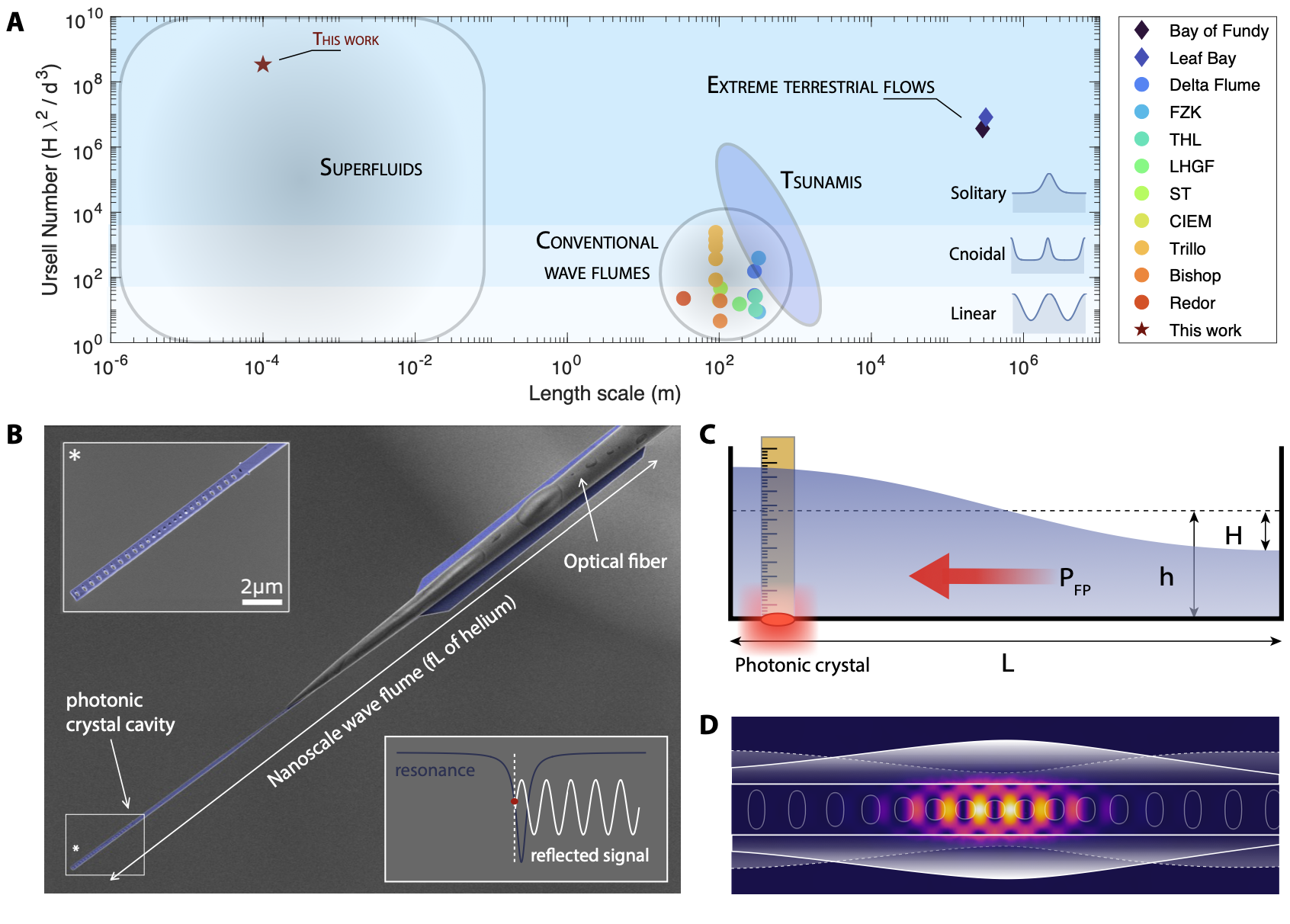
(A) Landscape of terrestrial shallow wave phenomena and flumes. Conventional wave tanks and flumes cluster in a small region of size and addressable Ursell number, far from extreme terrestrial flows (12). Superfluid-based approaches open up a significantly broader parameter space (see Supplementary Materials, Section 1.1). (B) False color scanning electron microscope image, showing the silicon wave flume (blue) addressed by an optical fiber taper (gray). Width and thickness (220 nm) being well below its length L, the device functions effectively as a one-dimensional channel (i.e. a wave flume). Top left inset: Photonic crystal cavity. (C) Illustration of the wave flume, including its fundamental sloshing mode. (D) Finite element simulation of the cavity optical mode at ∼ 1598 nm wavelength. The evanescent component extending outside the cavity senses superfluid wave motion, shown here with exaggerated amplitude (white line).
 Christopher G. Baker