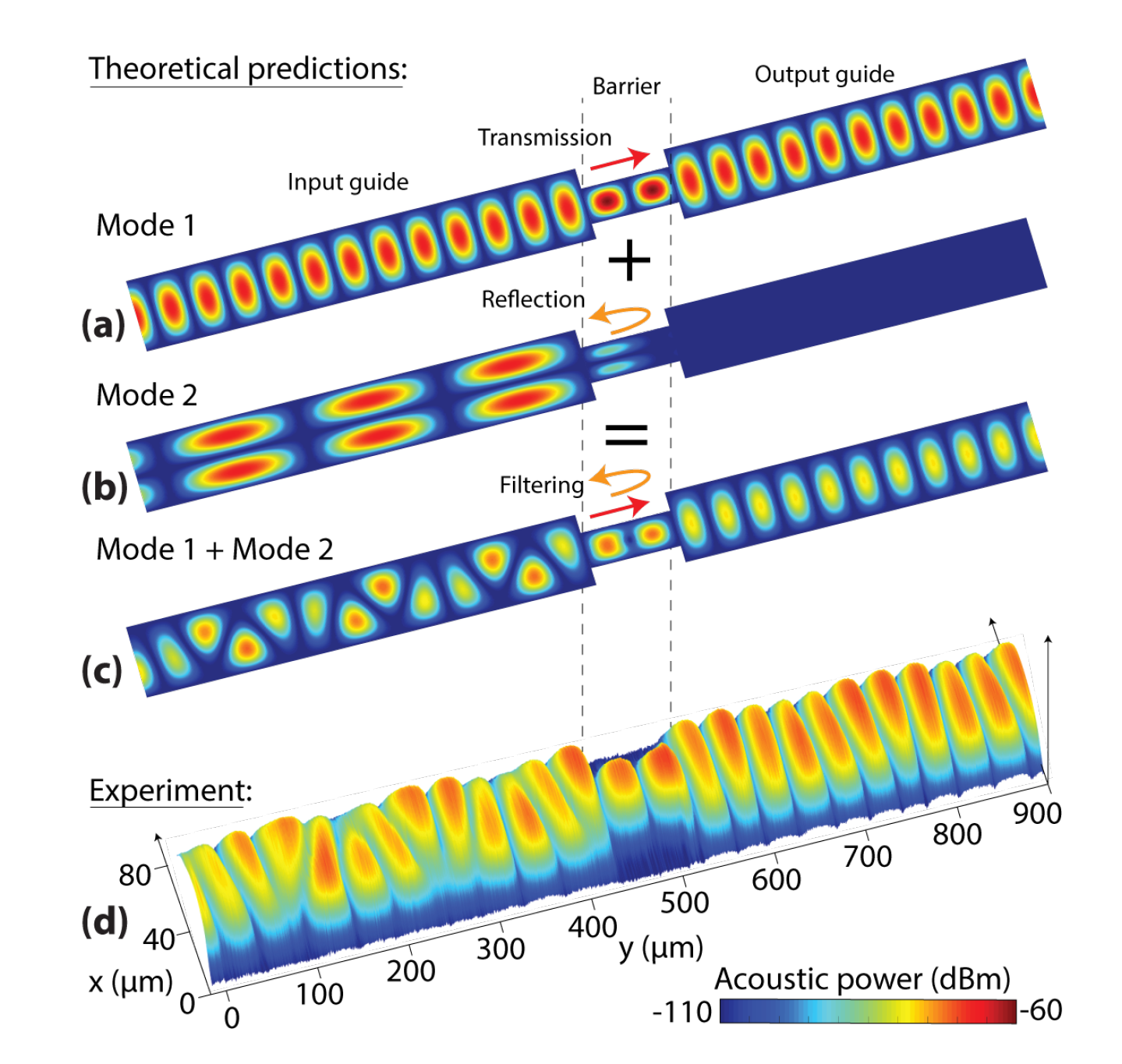
Acoustic mode filtering. (a)-(c) Theoretical predictions of the acoustic power of a device driven at a frequency between the guides second and third mode cut off frequency (a) Acoustic power if only the first mode is excited and (b) if only the second mode is excited for the same frequency. (c) corresponds to the interferenceContinue reading “acoustic-mode-filtering”
Acoustic mode filtering. (a)-(c) Theoretical predictions of the acoustic power of a device driven at a frequency
between the guides second and third mode cut off frequency (a) Acoustic power if only the first mode is
excited and (b) if only the second mode is excited for the same frequency. (c) corresponds to the interference pattern of the first
two modes with identical amplitude and is calculated by summing (a) and (b) over the entire device. (d) Experimental imaging
of a device with a 75 um long tunnel barrier driven at 8.1 MHz experimentally showing acoustic mode filtering. We believe
that both modes can be excited simultaneously in the input waveguide because the on-chip electrode is not symmetric in the
propagation direction. Note that in this configuration, due to resonances in the output waveguide, it is possible to selectively
enhance the second mode amplitude by driving at its resonance frequency even if it is greatly suppressed by the tunnel barrier.
The observed second mode amplitude in the output waveguide will be affected by these resonances and, even though filtering is
clearly evident, prevent an exact estimation of the filtering effciency. The experimental data was smoothed with a Gaussian
filter.
 Christopher G. Baker